The first stop
I had been deep in acquisition work and several other projects when a friend happened to have some time off. That was enough of a reason to get out of the normal routine, take Highway 14 to 395, and begin a road trip through the Eastern Sierra.
This was not a plan to disappear from work entirely. We brought Starlink, and I had my laptop with me, so I could use ChatGPT to create and revise scripts, check in on the acquisition, and handle a little work from camp. I was learning that staying connected and making room for an experience did not have to be opposites.
When I was younger, I probably would have considered the trip irresponsible. There was always more work to do. If I was not working, learning, or moving toward a measurable goal, I assumed I was wasting time. I wanted to live as efficiently as possible, although I am not sure I understood what all that efficiency was supposed to produce.
Today, I still work hard. That has not changed. But I understand something I did not understand at 18 or 20: a life cannot be measured only by its output.
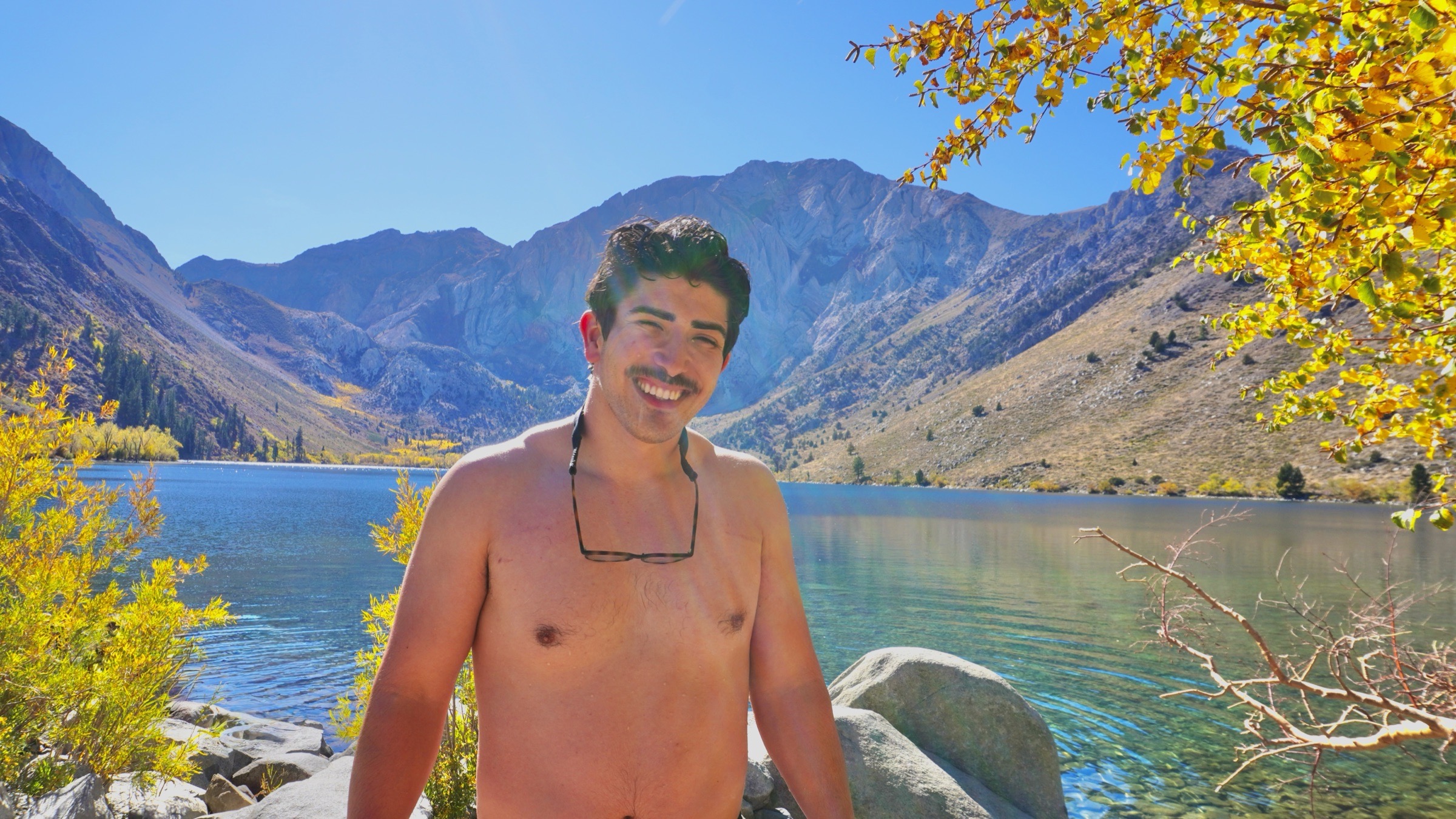
Convict Lake was our first stop.
A lake that did not feel this close to home
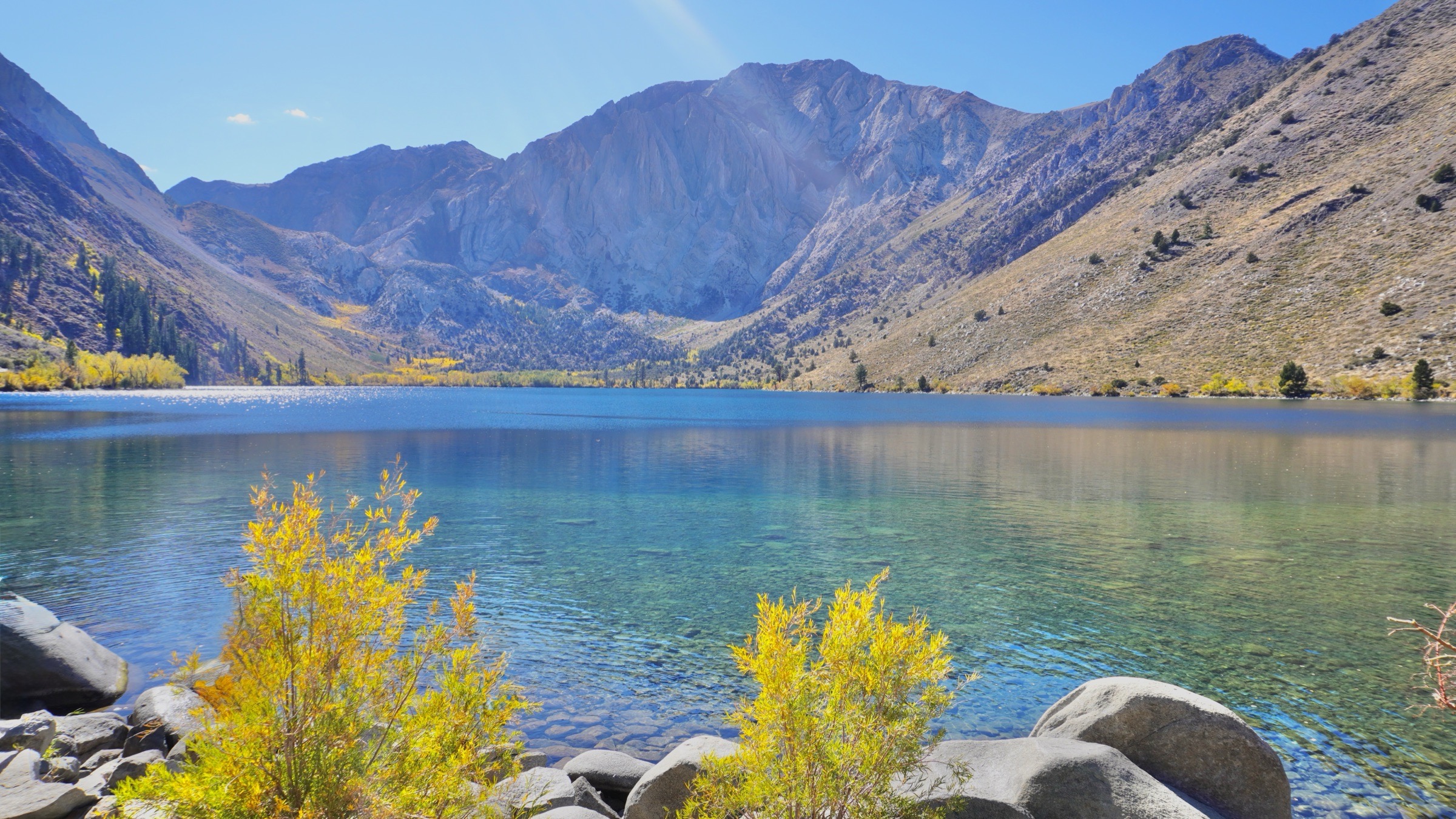
Convict Lake is not the biggest lake I have ever seen. That is not what made it extraordinary.
What caught me was the water. It was so clear that I could see the rocks beneath the surface from the shoreline. The lake sat below massive, exposed mountains, with bright fall colors wrapped around parts of the water. At the time, it was one of the most beautiful lakes I had ever seen.
The closest comparison I could make was to the Alpine lakes I saw in Switzerland. But Switzerland felt like a world away. Convict Lake is in California—close enough to reach by car from home. Realizing that something this beautiful was sitting in my extended backyard made it feel even more special.
Sometimes the places that change my perspective are not on the other side of the world. I simply have to leave my normal routine long enough to notice them.
My completely unnecessary swim
Whenever I find water during a trip, I usually want to get into it. I have done this in other countries and in random rivers. Once, while visiting Germany, I joined a group of locals who were swimming during their summer break. They called me “Unc,” and I got in with them. It became one of those strange, funny memories that would never have happened if I had remained a spectator.
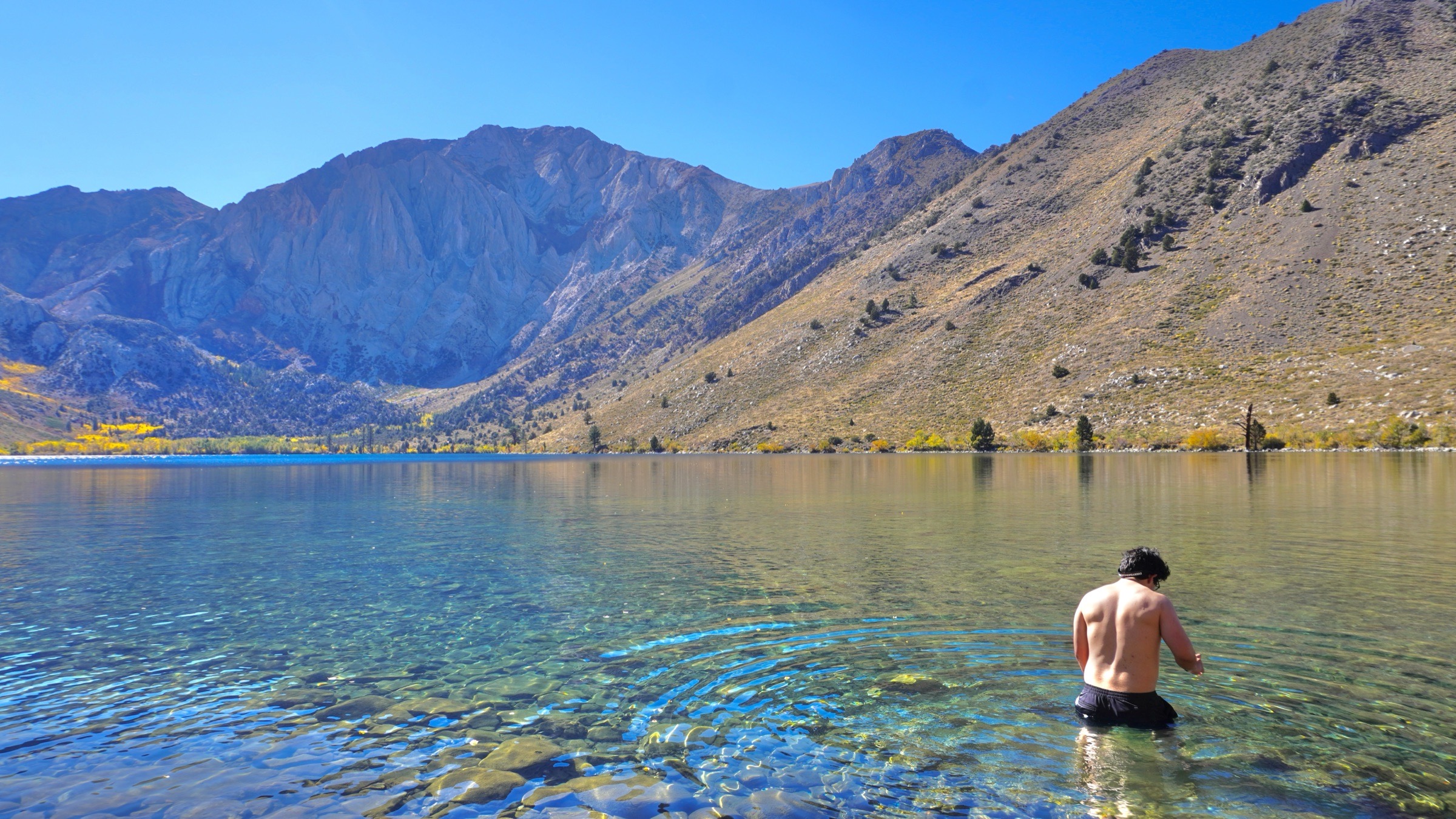
Convict Lake was no different. The air was warm and bright, but this was still a mountain lake. The water was cold enough to make every step feel very deliberate.
The bigger problem was the rocks. Because the water was so clear, I could see each one beneath my feet. What I could not see as easily was how much slick algae covered them. Every step felt like an opportunity to slip, land on another rock, and turn a great afternoon into a very different story.
So I did what any dignified adult would do. I dropped onto all fours and crawled into the lake like a monkey, swearing because I was cold and genuinely afraid of falling.
The photographs make the moment look peaceful. They do not capture all the expletives. That contrast is probably why I like them.
The other uncomfortable thing I did in public
Getting into the lake was not the only uncomfortable part of that stop.
I also recorded videos for YouTube while other people could see me. It was one of my first times speaking to a camera that openly in public, and it reinforced something I have been learning about media and public speaking.
To become good at almost anything, you first have to be bad at it. Most skills let you be bad in private. You can write terrible code before anyone sees it. You can rehearse a presentation in an empty room. You can test an idea quietly and discard it if it fails.
Media is different. A major part of the practice happens where people can watch you practice. You stumble over a sentence. Someone walks past. You become aware of your voice, your posture, and what strangers might think. Then you have to keep going.
For me, that may be the hardest part of learning to communicate publicly. It is not simply learning how to speak. It is accepting that the path to speaking well requires being visibly imperfect first.
Standing near Convict Lake with a camera made that fear concrete. But once I experienced it, it also became less powerful. The uncomfortable moment happened, I survived it, and there was no reason not to keep improving.
That is why I am continuing to invest in communication, media, and a public body of work. Not because I have mastered them, but because I have not.
What my younger self misunderstood
The younger version of me would have viewed this Eastern Sierra road trip as time taken away from progress.
Now I see that experience creates a different kind of value. Experiences give me perspective. They strengthen relationships. They give me stories, and stories become part of the connective tissue of relationships. A shared memory, an unexpected conversation, or even the story of crawling into a freezing lake can build a connection that pure achievement cannot.
That does not mean abandoning ambition. It means asking what the ambition is for.
I want to build companies, develop useful technology, serve people, and take on difficult work. I also want to travel, get outside, jump into cold water, laugh with friends, and see what is beyond my normal environment.
Those goals do not compete with one another. Together, they create the life I actually want.
Convict Lake was only the first stop on the trip, so it does not need to carry the meaning of the entire journey. It was simply a beautiful place, an unnecessarily cold swim, and a chance to practice being uncomfortable in public.
That was enough.
I work incredibly hard. I am proud of that. But I also know how to have fun, and this is what fun looks like to me: a friend, an open road, a place I have never seen, and a body of clear mountain water that I probably should—and almost certainly will—get into.
What to remember
- Adventure is not automatically time stolen from useful work.
- Learning to communicate publicly requires being visibly imperfect first.
- Ambition and a full life do not have to compete with one another.
STAY IN TOUCH
Follow the record as it is built.
Tim shares plain-English lessons from building companies, serving communities, and improving institutions—work that is developing the judgment and operating range for broader responsibility over time.