EVIDENCE & LIMITS
Source note: This is my four-job AI work test. The sample work record below is made up to show how the checks work. It is not a customer case, a product feature or a measured result.
Give AI one clear job
“Use AI at work” is not a clear plan. It is too wide. No one knows what to do, what to check, or who owns the result.
I use four words: draft, route, flag, and record. These jobs can help a team move fast. They do not give the tool the last word.
Draft, then check the work
A draft can save time when a person can judge it fast. AI can sort notes, make a reply plan, list next steps, or build a check list from known facts.
The review is not a flaw. It is a guardrail. The person should know the source, the goal, and what can go wrong.
Route and flag the right work
Route means send an item to the right owner. Flag means show that owner what needs care. Both can cut wait time without letting AI make the last choice.
These jobs are a good place to start. The team can test the rules, see who gets each item, and check if the handoff got faster.
Record so the team can learn
A team can lose good work when key choices live in a chat or one mind. A clear record says what happened, why it happened, who owns the next step, and what came next.
The record must be easy to check. People should know what AI saw, what it guessed, and how to fix it.
Keep big choices with people
Some choices can hurt safety, money, jobs, trust, or private data. A named person should own those choices. The team also needs good facts and a clear way to ask for help.
This test is not a call to make all work automatic. It helps AI support the team while people keep the duty to act with care.
Keep the suggestion, yes and result apart
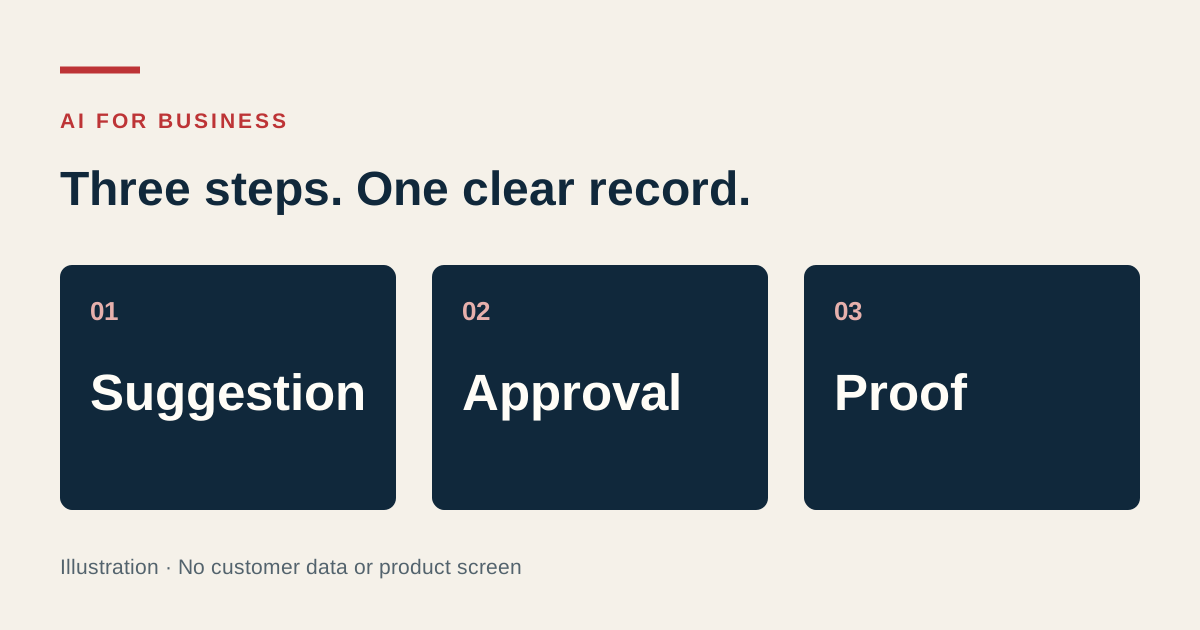
A suggestion is what AI thinks should happen. Approval is what a person allows. The result is what we can check after the action. Save each one on its own. A draft is not a sent reply. A yes is not proof that the reply went out.
Here is a made-up example. AI drafts a reply to a new service request. It asks for the trade and city. It makes no price or crew promise. The office checks that exact draft before it can be sent.
The record should keep five things: the original request, the exact draft, the role that approved it, the allowed action and the checked result. Keep this record private. The team does not need to publish the customer’s words or contact details.
A sample work record
Task: prepare one reply that asks for missing service details. Source: the original request. AI job: draft and flag. Status: waiting for office review.
Allowed action: send this checked draft once to the requester. Owner: the office role with power to approve it. Limits: no price, booked visit or new promise. Keep the approval tied to the exact text and recipient.
Checked result: record the send receipt if it exists. If there is no receipt, write ‘send not confirmed.’ Do not mark the work done just because the draft was saved or approved. These are sample fields, not a claim about what MIQ or another tool does.
Changed work needs a fresh check
If the text, recipient or promise changes, the old yes may no longer cover the task. Put the changed work back in review. Do the same when the facts change or the approval is withdrawn.
A receipt may still show an error or a failed action. Keep that result. Name the next owner and step. Do not let a retry turn one approved reply into two sends.
Use the five human-review checks to set the limits. If the handoffs are still unclear, map the work first. The point is to let the next person see what is allowed, what happened and what still needs care.
Know when the four jobs are not enough
Draft, route, flag, and record are support jobs. They are not approval. Put a person in front of any action that can move money, affect a person, expose private facts, publish a claim, or make a hard-to-undo change.
Use the human-approval checklist in the related reading below. It gives the team five clear stop points and names what a person should check before the work moves.
TRY THIS
The four-job AI work test
Pick one task the team does more than once. Name the AI job, the facts it can use, and the person who owns the result.
- 01 · DraftMake a first draft for a person to check.Use it for notes, replies, lists, and plans that need a review.
- 02 · RouteSend work to the right person.Use it when the rules are clear and a person still owns the next step.
- 03 · FlagShow a risk, miss, or item that needs help.Use it when finding a problem matters more than giving the last word.
- 04 · RecordSave what happened in a clear form.Use it for choices, handoffs, results, and notes the team may need.
COMMON QUESTIONS
Questions about MIQ and the CAYRF project
Does an approved AI draft mean the work is done?
No. Approval allows the exact action. Keep separate proof that it happened. If that proof is missing, mark the result unconfirmed.
What if the draft changes after approval?
Check whether the old approval still covers the changed text, recipient and promise. If it does not, return the work to review before acting.
What to remember
- Give AI one job: draft, route, flag, or record.
- Name the facts, owner, and good result.
- Keep a person on big or risky choices.
- Keep the suggestion, exact approval and checked result apart.
- Return changed work to review and keep failed actions visible.
- Track if the work got better, not if the team used AI.
STAY IN TOUCH
Follow the record as it is built.
Tim shares plain-English lessons from building companies, serving communities, and improving institutions—work that is developing the judgment and operating range for broader responsibility over time.