
EVIDENCE & LIMITS
A November 8 work note about an IQ automation-safety update published November 7. Release checks support the described controls. They do not prove every live workflow is free of repeat actions.
An unclear result needs its own next step
A tool can finish an action and still fail to save the final done record. If the next step is simply to try again, it may repeat work that already happened.
That distinction matters when I direct the work on MasterlineIQ. A task starting, an action happening and the result being saved are separate things. I want to know which part we have proof of.
What changed in the latest IQ work
The automation-safety update published on November 7 improved how a worker claims a task. It added clearer handling for work whose completion is uncertain and warnings when a task has been held too long.
A claim is the record that a worker has taken responsibility for a task. If that record expires, a second worker should not blindly assume the first worker did nothing.
The important change is the pause for a check. Uncertain work is held for review before another action is allowed. I am describing the released control, not claiming that it has removed every possible repeat action from the business.
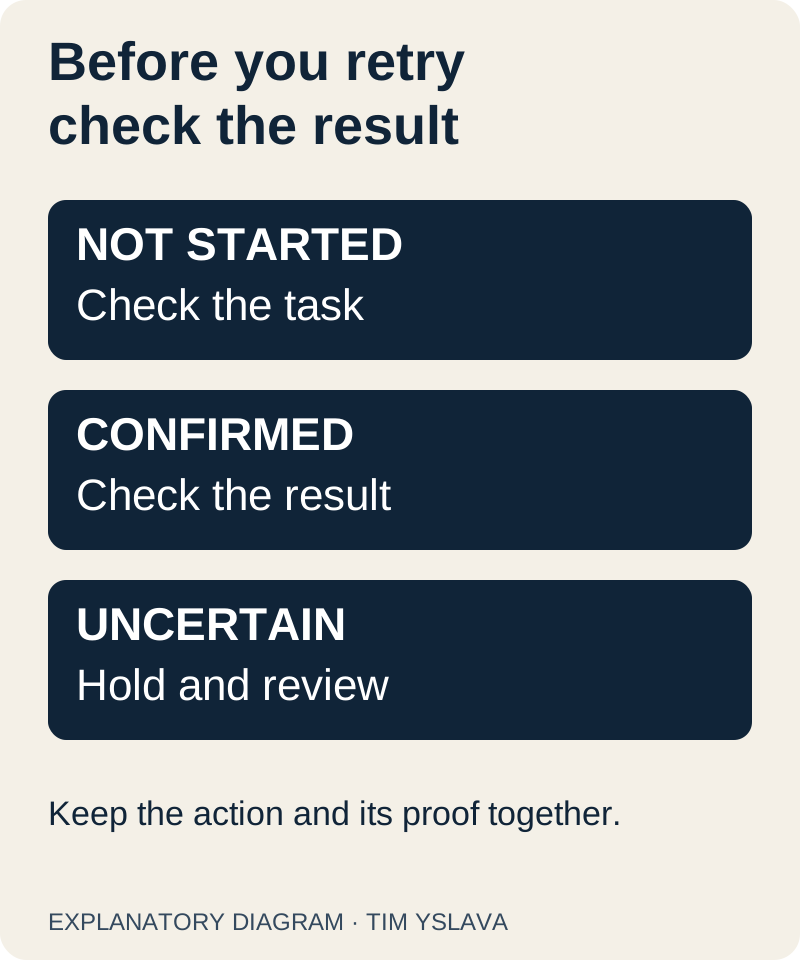
Three states are more useful than one green light
Not started means there is evidence that the action has not begun. Confirmed complete means the result can be checked. Uncertain means the available record does not settle the question.
Those states need different responses. Treating uncertain as failed can create a second action. Treating it as complete can hide unfinished work.
Amazon’s guide to safe retries explains a related idea called idempotency: designing an action so that an allowed repeat does not add another effect. That engineering pattern is useful. It is not a reason to assume every tool already has it.
What I would ask before pressing retry
Can I see the result in the system that was supposed to change? Is there a receipt for the action? Is another worker still handling it? Could repeating it send another message or create another record?
If the answers are unclear, save the current state and give one person the review. Keep the task, result and decision together. Do not erase the failed record just to make the dashboard look clean.
This is part of giving an AI system a safe way out. A blocked task can still leave the team with a clear next action.
The control is progress. The result still needs checking.
The release and its checks are useful evidence. They are not a measurement of customer outcomes, time saved or every future automated run.
For an owner, the practical question is simple: when a tool cannot tell you what happened, does it repeat the action, or does it help you find out?
That is a question worth asking before the next retry.
SOURCES